
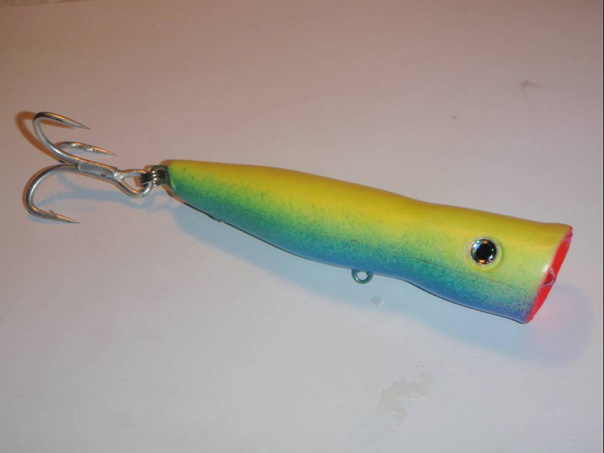
Guide

Fabricate

Manufacturing method in Bricorese

Learn how to make a hard lure in resin, from the design of the Master in Balsa to the finishes.
Carry out a mold Double hull, then make a solid reinforcement with piano rope with its ballast.
Pour the bricorese with a suitable load to get a floating or flowing lure perfectly balanced.
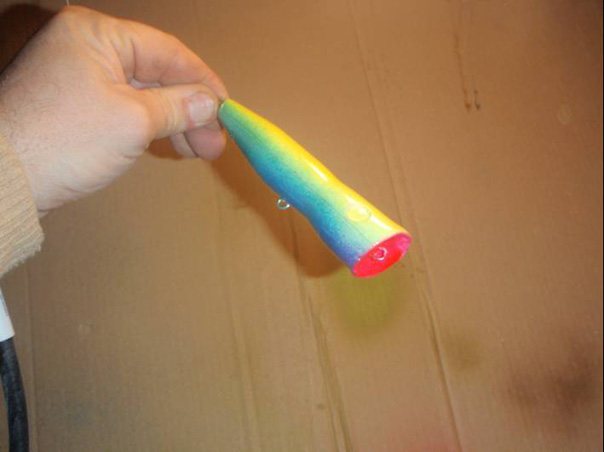
Finalize your homemade lure with neat sanding, a paints to the airbrush, 3D stick-on lure eyes and a protective varnish.

1 - Master's Design

We start by cutting a balsa block with the approximate dimensions of the lure to make, then we sculpt the shape before having sanding, at the paints and the opening. Today, it is also possible to design the master's master and then manufacture it using a 3D printer. Regardless of the method chosen, the surface of the master must be perfectly smooth and shiny in order to obtain a mold clean and precise.

2 - Manufacture of the mold double Hull

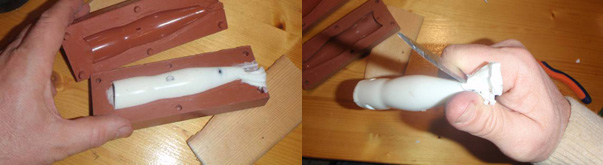
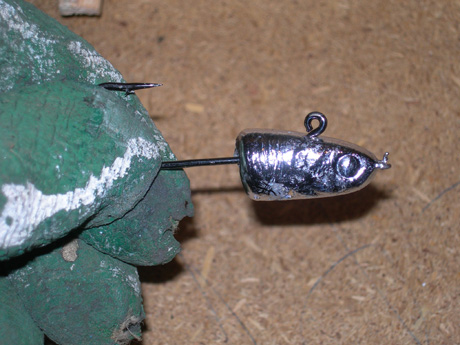
We will refer to the manufacturing card of a double-shell leaded head. We will get a mold in 2 parts.

The position of the casting cone will depend on the shape of the lure. For a popper, it will be towards the rear end. Vents will be pierced to evacuate the air contained in the mold.

3 - Framing the reinforcement

It will be performed with piano rope by folding with a loop clamp.

A ballast will position on this frame to balance the lure. Balancing is important for several reasons, starting, resting in the water and swimming. Rattle can be added.
4 - Fabrication of the lure

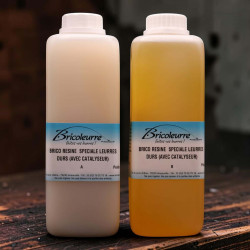
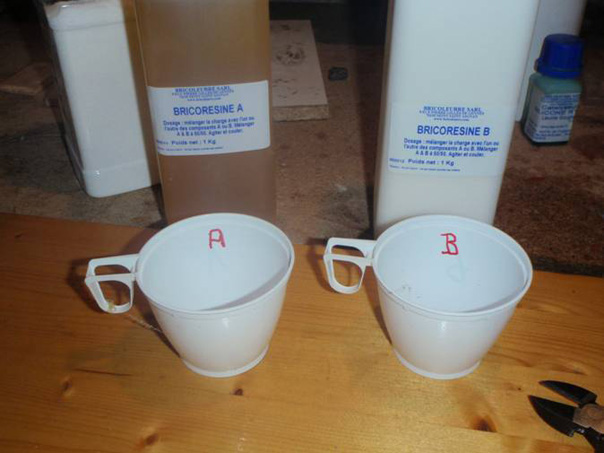
The principle is the following, we mix with a resin Bi-components (a and b) a hollow glass micro-balloons (lightweight) or heavy. Light to get a floating lure, heavy for a flowing lure.

Some technical data:
- The density of resins A + B is 1.1
- The density of the light composite load for bricoresin is 0.25 (1 g = 4 cm3)
- the density of the heavy composite load for bricoresin is 2.55
- the quantity of composite load light for Bricoresin to add is, according to our tests, 15% of the weight of A + B

4.1 Preparation of the resin (example for a floating lure of 115 g):

4.1.1. Mix in a cup 50 g of bricoresin a + 7.5 g of light composite load for bricoresin
4.1.2. Mix in another cup 50 g of bricoresin b + 7.5 g of light composite load for bricoresin

4.1.3. wait 10 mn then re-mix

4.1.4. pour A in B

4.1.5. mix energetically for 30 seconds
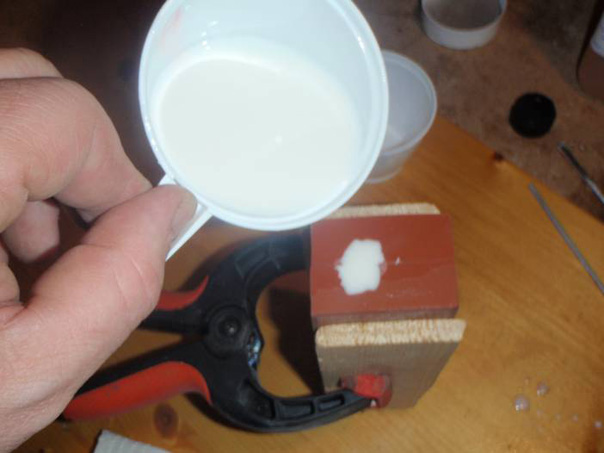
4.2 Pouring the resin

It must intervene in the minute following the contents of the contents of the 2 cups because the gelation starts very quickly. If we wait too much, it will be impossible to fill the mold.

4.3 demolding

It must intervene 20 minutes after casting. Failure to comply with this delay may result in a deformation of the still fragile lure. We can then delete the casting cone. Sanding will be needed to remove any trace of the cone.

4.4 paints

It can be done using aerosol bombs or the airbrush. Three layers of colorless varnish will be applied.

4.5 decoration

Eyes can be glued to the Cyanocrylate glue.

Make your hard lures

BRICORESINE HARD LURES 2 KG (2X1 KG)

003. BRICORESINE HARD LURES 2 KG (2X1 KG)

€59.00
HEAVY COMPOSITE CHARGE FOR BRICORESINE 1 KG

HEAVY COMPOSITE CHARGE FOR BRICORESINE 1 KG

€7.00
BRICOVERNIS

BRICOVERNIS

€13.00
BRICOVENIS PRO

BRICOVENIS PRO

€199.00

Découvrez nos autres guides et astuces